







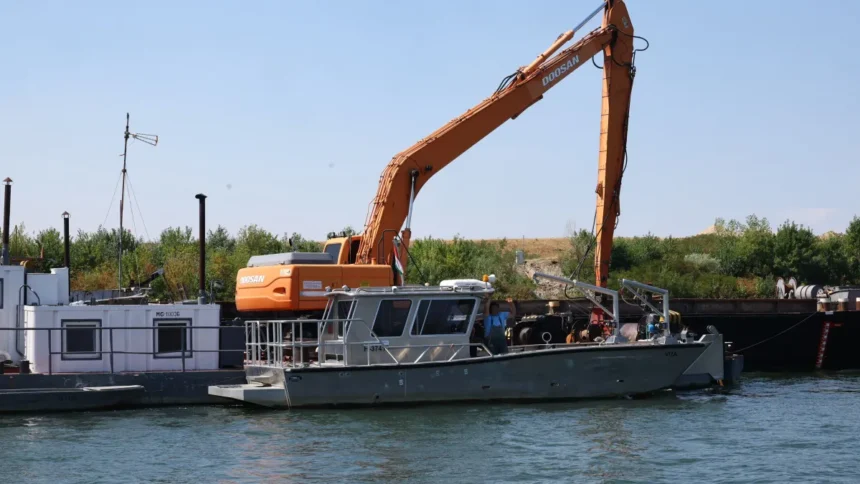
The construction work at the Paks nuclear power plant is going well, according to a recent announcement from the Hungarian Minister of Defence. On his official social media page, he shared that the work is progressing so smoothly that the barges, which had been intentionally sunk in the Danube River, can now be removed. This is a significant step in the project to ensure the safe and efficient operation of the power plant.
The minister explained that the water level of the Danube at Paks has now risen enough to allow for the start-up of additional turbines this coming Sunday. In a video posted alongside his announcement, filmed on the newly constructed stone water structure, he stated that the continuous work is bearing fruit. The stone structures built on both the left and right banks of the river are now more effective at damming the water back than the sunken barges ever were.
With the barges removed, they can now be put to work on another important task: helping to scatter stones into the deeper parts of the river, primarily on the right bank. This stone-scattering is a crucial part of reinforcing the riverbed and banks.
- Progress on construction work
- Removal of sunken barges
- Start-up of additional turbines
- Construction of stone structures
- Stone-scattering for reinforcement
- Challenges on the right bank
The minister also provided an update on the scale of the work. So far, on the left bank alone, approximately 2,500 cubic meters of stones have been placed. The amount needed on the right bank is several times greater. While soldiers have already built a 194-meter-long section on the left side, work on the right bank is more challenging because the water is much deeper there, but it is continuing without pause.



| Aspect | Left Bank | Right Bank |
|---|---|---|
| Stone Volume Placed | Approx. 2,500 m³ | Greater than left bank |
| Length of Section Built | 194 meters | Ongoing |
| Water Depth | Shallow | Deep |
This progress marks an important infrastructure milestone for the development of the Paks nuclear power plant, showcasing the steady efforts to secure Hungary’s energy future.